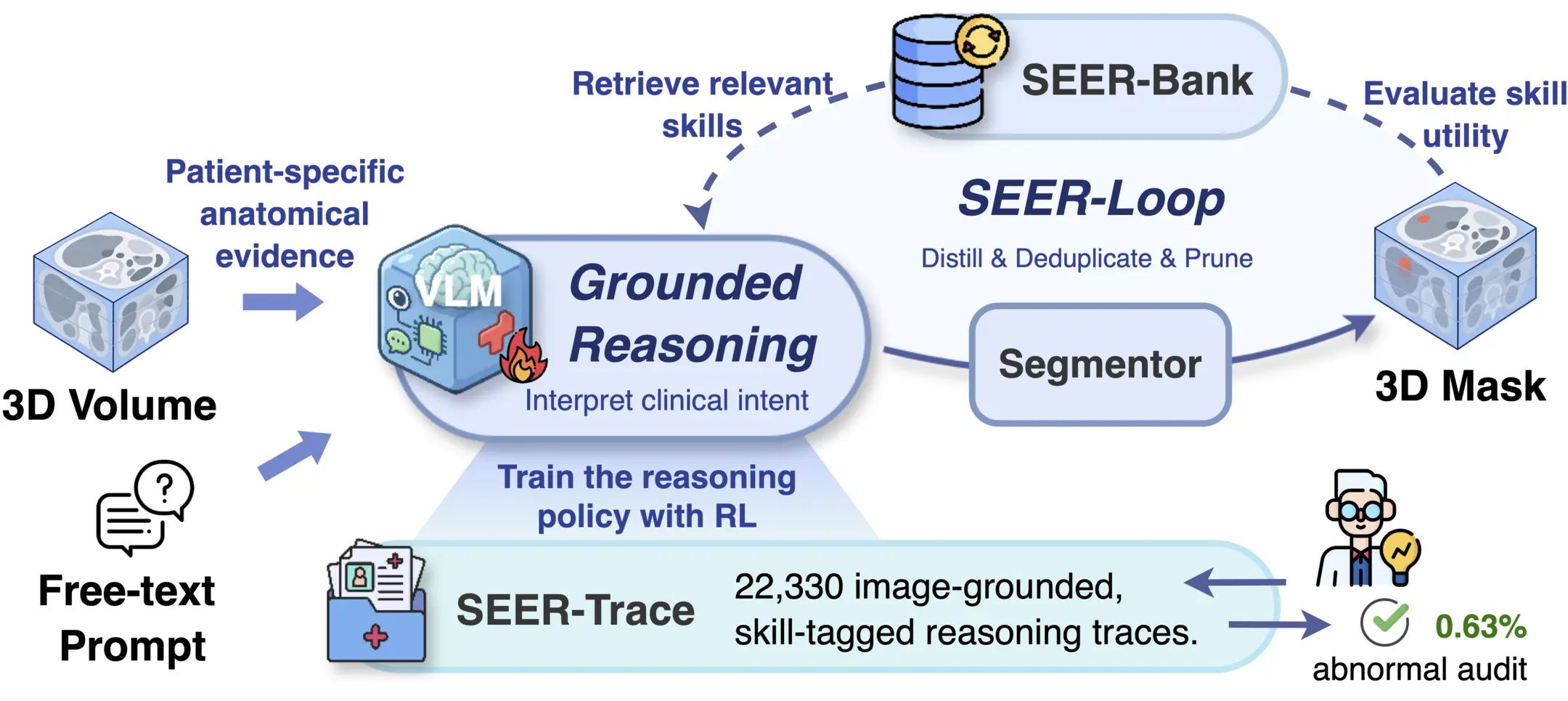
Free-text promptable 3D medical image segmentation offers an intuitive and clinically flexible interaction paradigm. However, current methods are highly sensitive to linguistic variability: minor changes in phrasing can cause substantial performance degradation despite identical clinical intent. Existing approaches attempt to improve robustness through stronger vision-language fusion or larger vocabularies, yet they lack mechanisms to consistently align ambiguous free-form expressions with anatomically grounded representations.
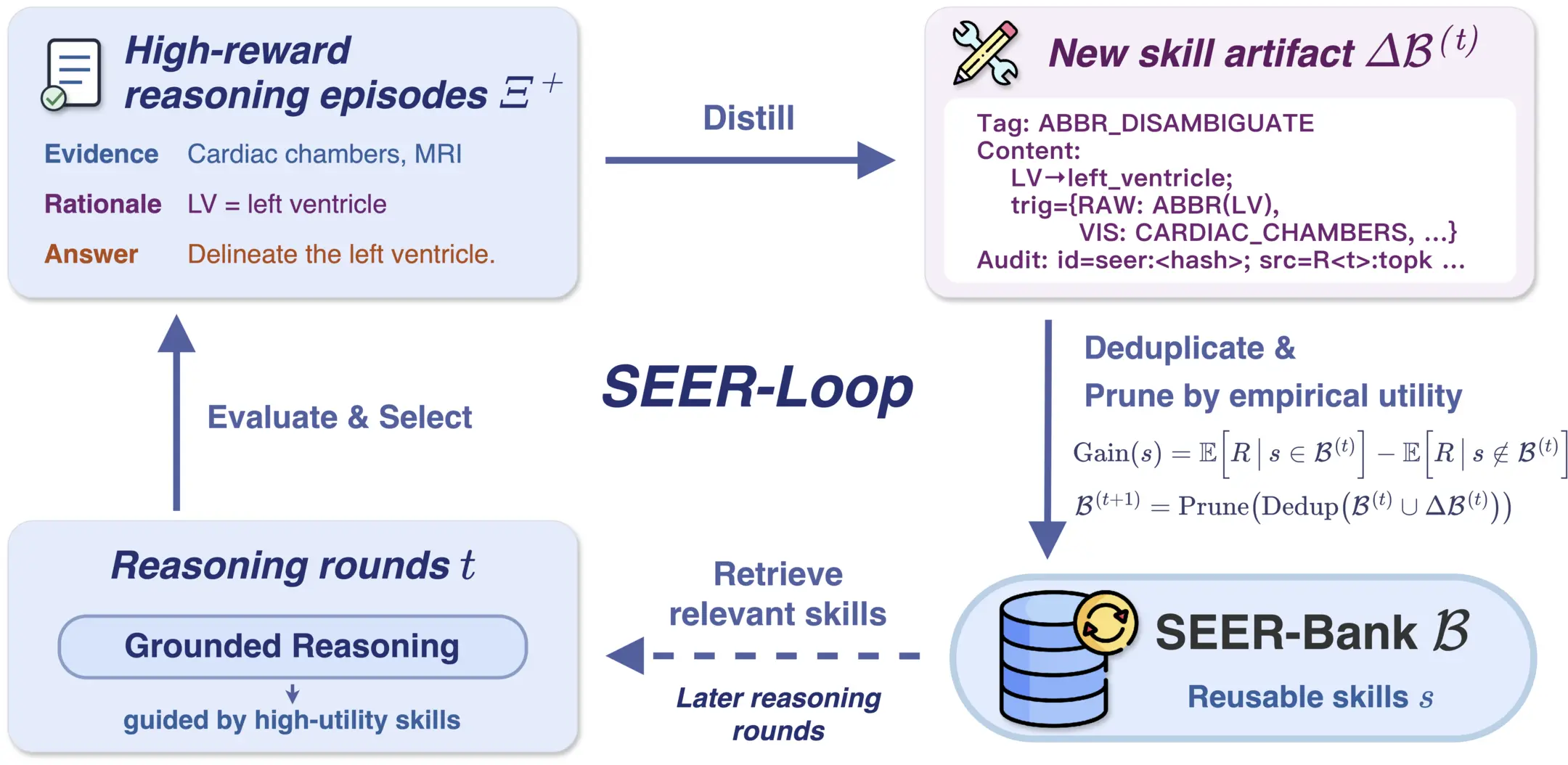
We propose Skill-Evolving groundEd Reasoning (SEER), a novel framework for free-text promptable 3D medical image segmentation that explicitly bridges linguistic variability and anatomical precision through a reasoning-driven design. First, we curate the SEER-Trace dataset, which pairs raw clinical requests with image-grounded, skill-tagged reasoning traces, establishing a reproducible benchmark. Second, SEER constructs an evidence-aligned target representation via a vision-language reasoning chain that verifies clinical intent against image-derived anatomical evidence, thereby enforcing semantic consistency before voxel-level decoding. Third, we introduce SEER-Loop, a dynamic skill-evolving strategy that distills high-reward reasoning trajectories into reusable skill artifacts and progressively integrates them into subsequent inference, enabling structured self-refinement and improved robustness to diverse linguistic expressions.
Extensive experiments demonstrate superior performance of SEER over state-of-the-art baselines. Under linguistic perturbations, SEER reduces performance variance by 81.94% and improves worst-case Dice by 18.60%.
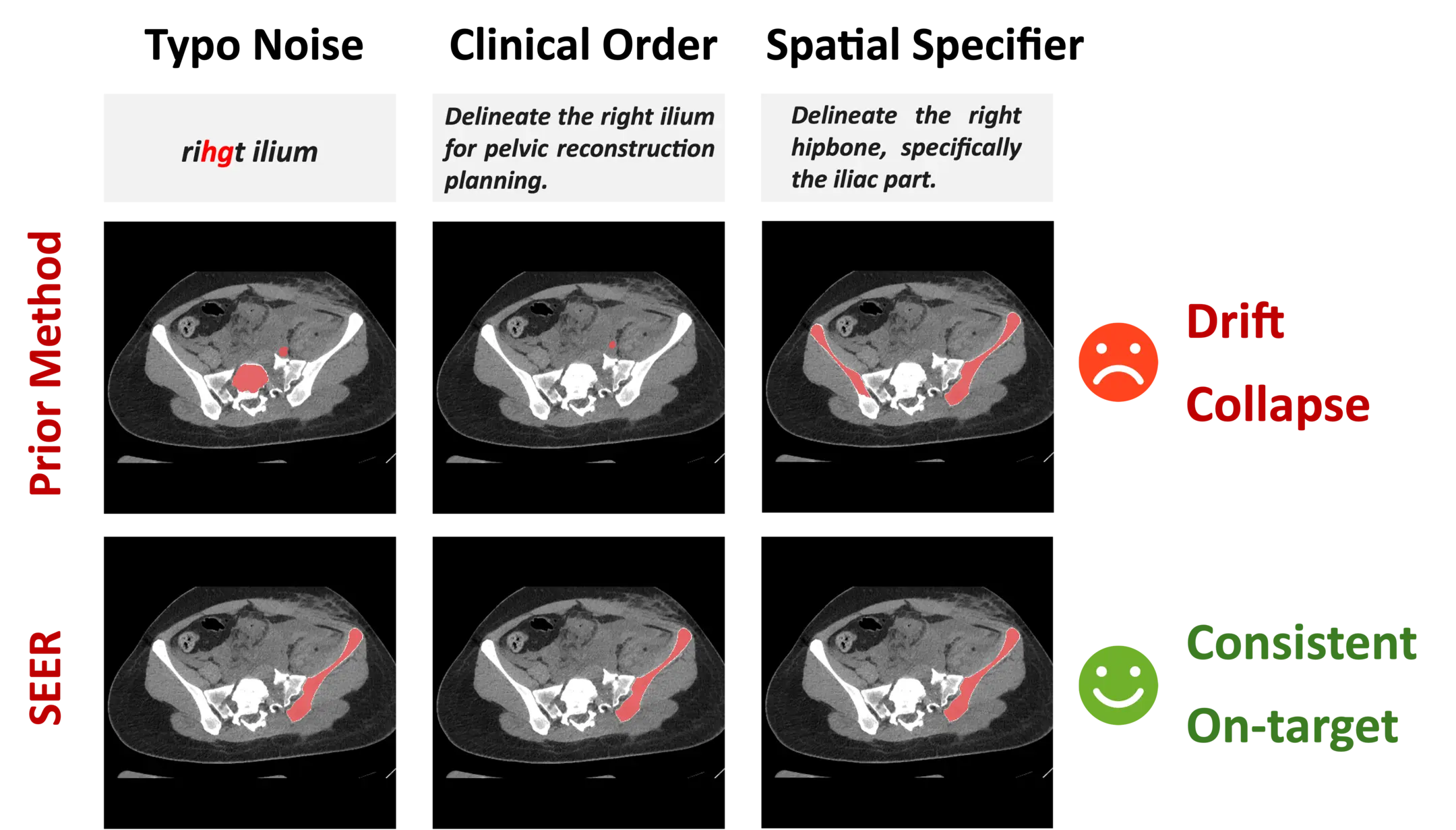
Same clinical intent ≠ Same segmentation
SEER-Trace pairs clinical prompts with 22,330 image-grounded, skill-tagged reasoning traces to train the reasoning policy.
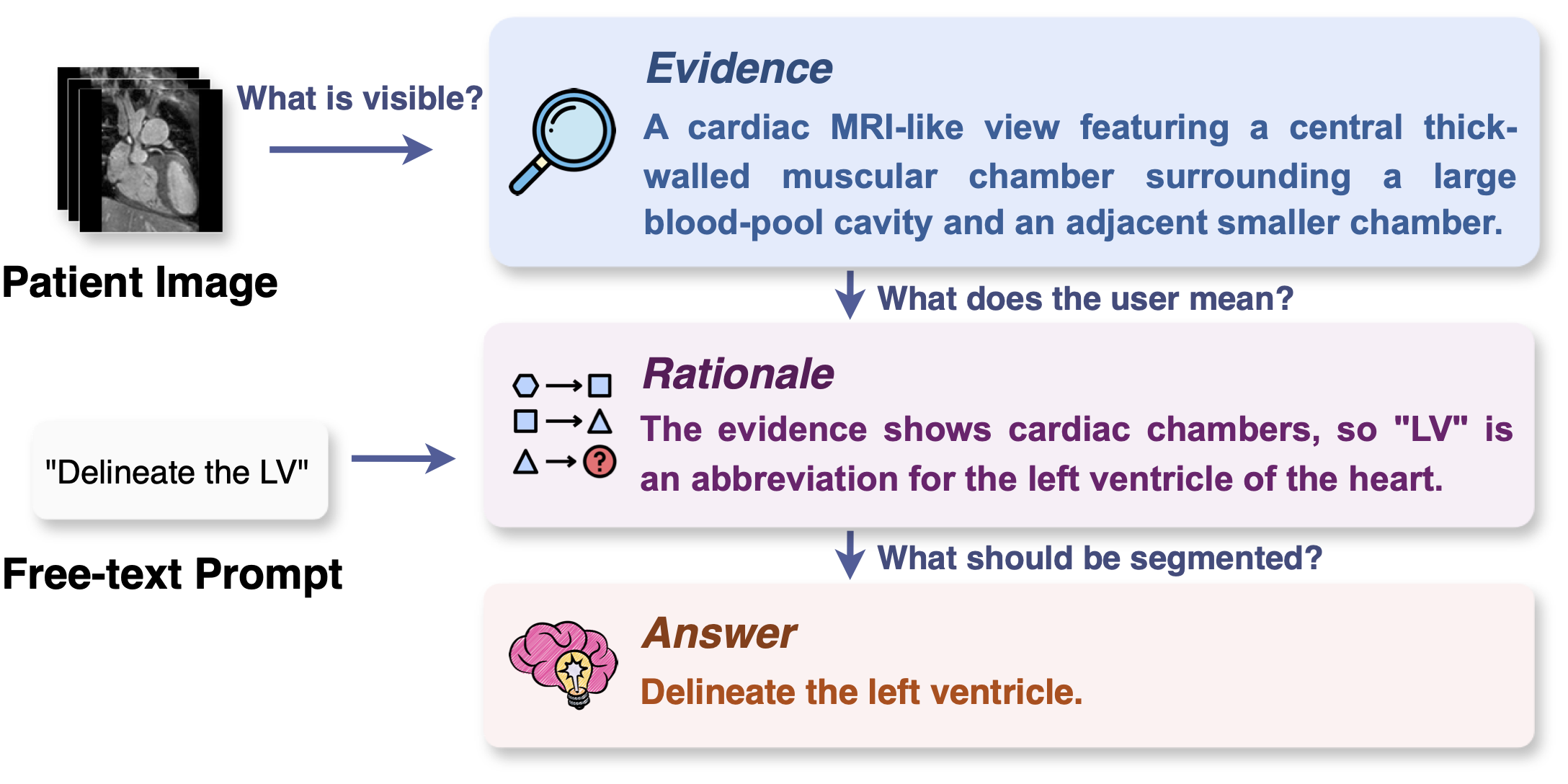
SEER uses patient-specific anatomy to interpret clinical intent.
SEER-Loop distills high-reward reasoning into reusable skills, refines SEER-Bank, and retrieves relevant skills for later reasoning rounds.
We evaluate SEER on two out-of-distribution benchmarks and compare it with strong 3D medical segmentation baselines under both native label prompting and realistic free-text clinical prompting.
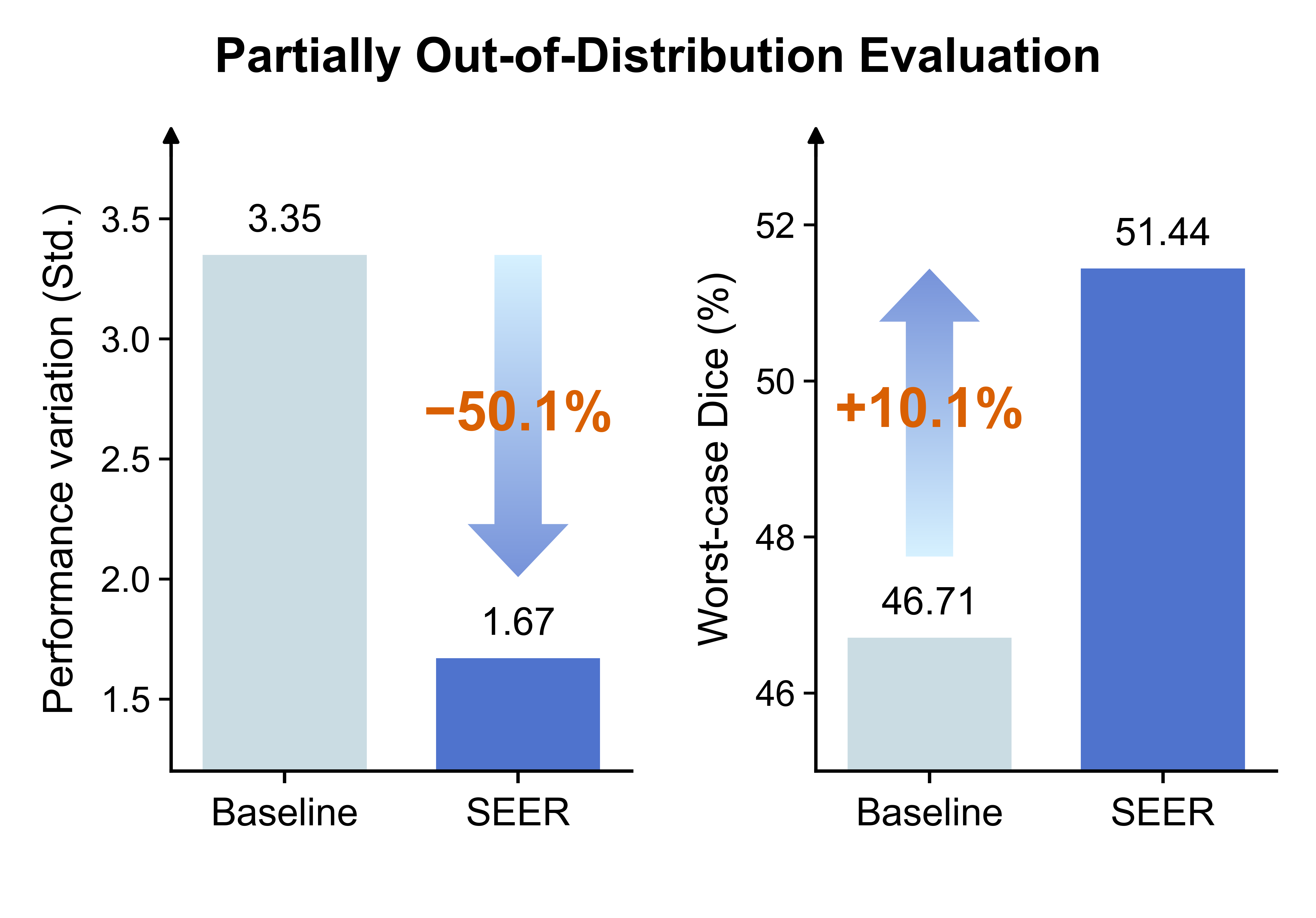
Partial OOD: unseen sources and target labels within the brain anatomical domain.
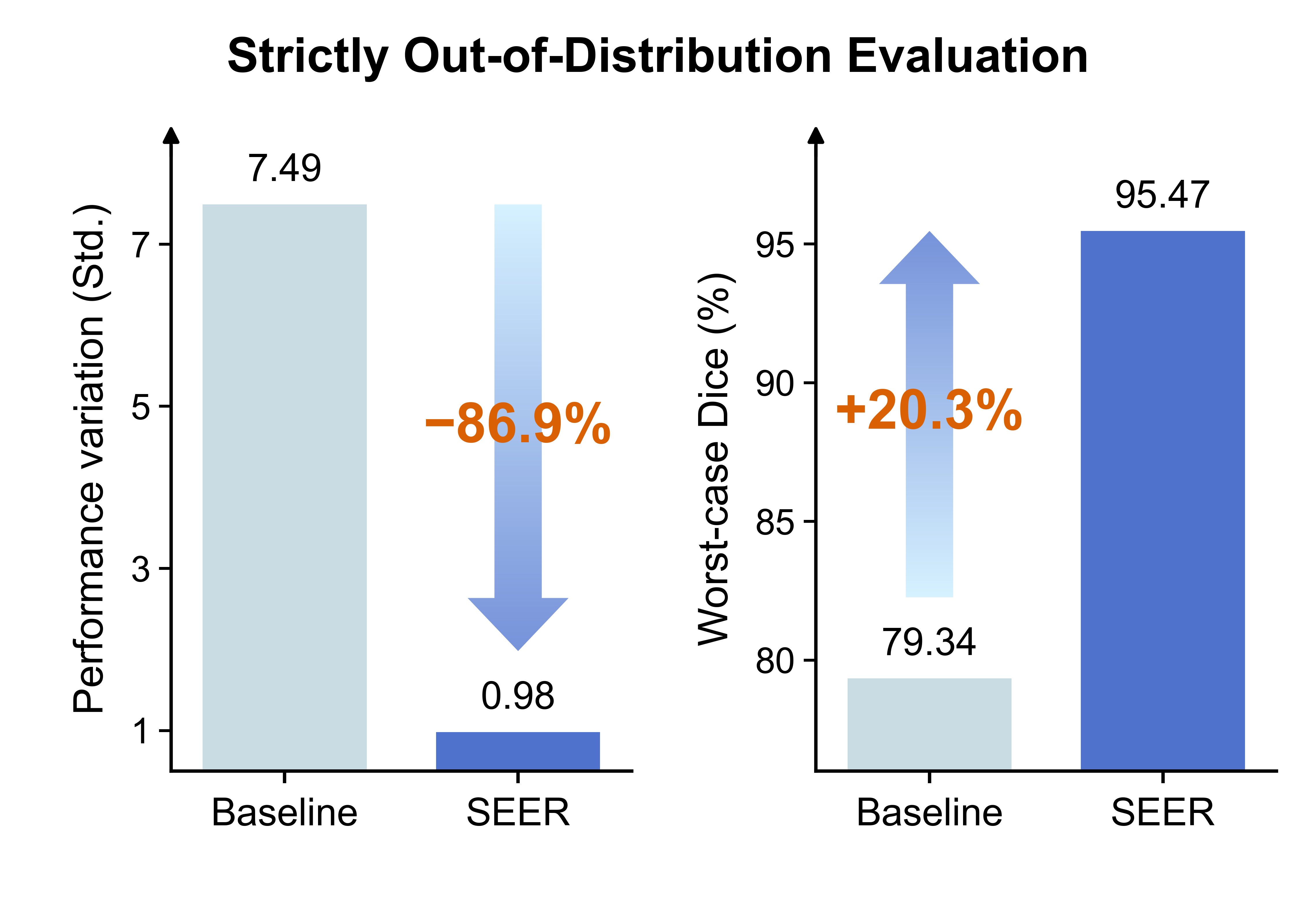
Strict OOD: pelvic anatomy and target labels absent from SEER-Trace coverage.
SEER improves free-text Dice and robustness across both benchmarks.
| Dataset | Method | Label Prompting | Free-text Prompting | ||
|---|---|---|---|---|---|
| Dice ↑ | Dice ↑ | Worst Dice ↑ | Std. ↓ | ||
| BrainMetShare | SAT | 22.16 | 0.69 | 0.00 | 2.53 |
| BiomedParseV2 | 18.66 | 2.53 | 0.00 | 7.27 | |
| Text3DSAM | 0.10 | 0.41 | 0.00 | 0.93 | |
| MedSAM3 | 11.33 | 16.62 | 10.56 | 5.17 | |
| VoxTell | 48.19 | 52.15 | 46.71 | 3.35 | |
| SEER (Ours) | 51.70 | 53.83 | 51.44 | 1.67 | |
| PENGWIN | SAT | 96.05 | 0.01 | 0.00 | 0.13 |
| BiomedParseV2 | 1.35 | 8.53 | 0.00 | 7.50 | |
| Text3DSAM | 24.75 | 0.01 | 0.00 | 0.16 | |
| MedSAM3 | 18.26 | 5.75 | 3.67 | 6.40 | |
| VoxTell | 97.59 | 92.26 | 79.34 | 7.49 | |
| SEER (Ours) | 97.56 | 97.39 | 95.47 | 0.98 | |
| Configuration | Dice ↑ | Worst Dice ↑ | Std. ↓ |
|---|---|---|---|
| Baseline | 92.26 | 79.34 | 7.49 |
| + Vanilla VLM | 84.84 | 61.90 | 14.15 |
| + Fine-tuned VLM w/ Grounded Reasoning | 95.92 | 88.27 | 3.84 |
| + SEER-Loop (Ours) | 97.39 | 95.47 | 0.98 |
Grounded reasoning and SEER-Loop improve accuracy and robustness, while naive VLM-based text parsing degrades performance.
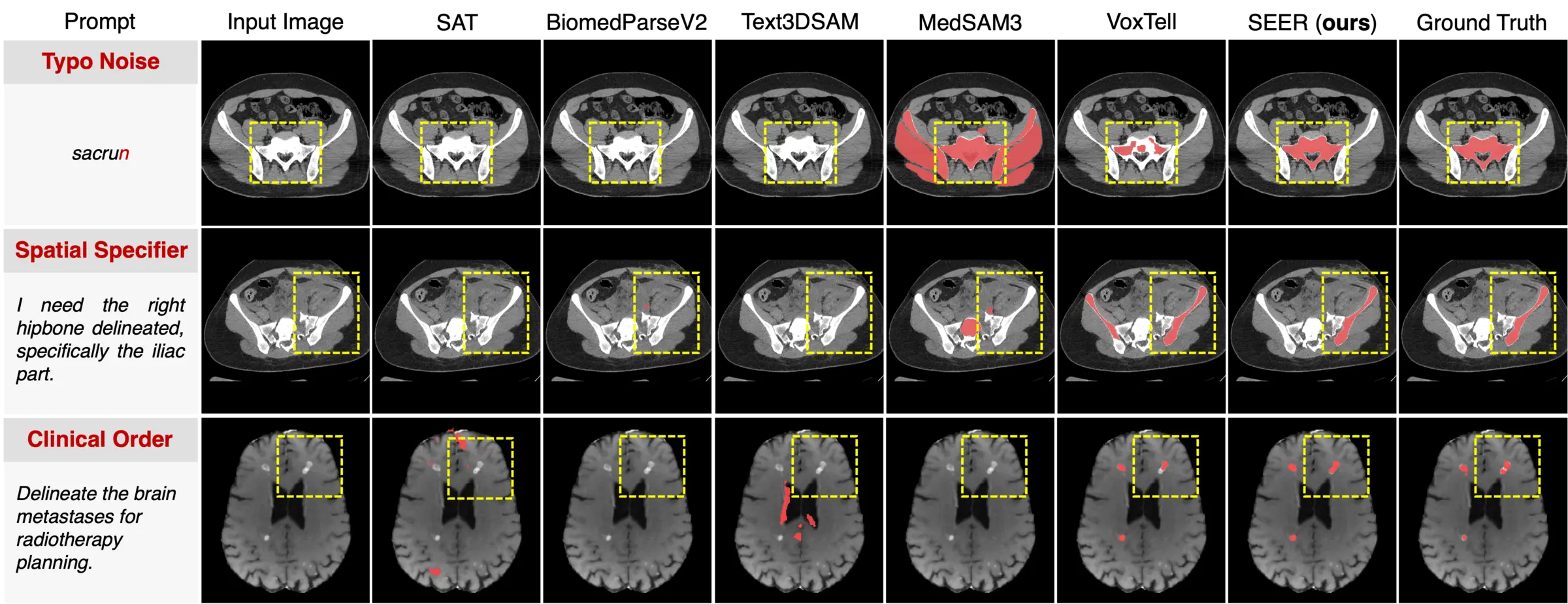
Across typo noise, spatial specifiers, and clinical orders, SEER produces on-target masks grounded in the image.
Stay tuned for SEER V2Coming soon
Towards Reliable Medical AI for Real-World Clinical Workflows!
@article{zhang2026skill,
  title={Skill-Evolving Grounded Reasoning for Free-Text Promptable 3D Medical Image Segmentation},
  author={Zhang, Tongrui and Wang, Chenhui and Li, Yongming and Chen, Zhihao and Zhan, Xufeng and Shan, Hongming},
  journal={arXiv preprint arXiv:2603.08215},
  year={2026}
}